On Joseph Anton and Salman Rushdie
The lit blog has been update with a post that took longer and grew longer that expected. An extraordinary life.
Link: lit blog
Link: lit blog
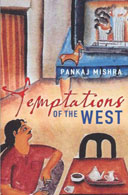
Reading Ramachandra Guha's India after Gandhi and Pankaj Mishra's Temptations of the West. This was rather by accident, but they make good reading side-by-side.

In Elif Batuman's article on a Turkish chef who is reviving authentic Turkish cuisine I came across a seemingly unbelievable fact:In Turkey, a turkey is called 'hindi'. These birds are quite a part of Turkish culinary culture and they are usually eaten on New Year's eve. Much like in France you don't order French fries but pommes frites, I did suspect that in Turkey they don't call the turkey 'turkey'. But 'hindi'?!
Knowing how maddening it is to hear the confusion between Hindu and Hindi, I suspected for a moment that the Turks meant something else. I had this checked with my Turkish friend. This was her response:
"Hindistan is the name of the country India in Turkish! And the name of the bird does actually come from the name of the country, as the latter used the be called “the bird from India” or something like that. The word Hindi, however, is no longer used to refer to Indians (perhaps because of its use as a bird name). Now we have the word Hintli, which means “Indian”. So hindi is only part of the name of the country today. "So, turkeys are from India or thought to be so by the Turks at least. I really doubt that I ever saw a turkey in India and, if my memory serves me right, Salim Ali's masterwork The Book of Indian Birds" has no mention of turkeys of any kind (but this I need to check). So, if turkeys are not from Turkey, and unlikely to be from India, where is this bird from? The Wikipedia article is not terribly clear on the Turkey-India connection to the etymology either(I checked). The article seemed to suggest a perverse perpetration of the mistaken Columbian idea that America was really India.
And just to keep this ball rolling…all over the world, people now can eat American Turkeys, but they don't call them Turkeys.
Across Arabia, they call our bird "diiq Hindi," or the "Indian rooster."
In Russia, it's "Indjushka," bird of India.
In Poland, "Inyczka"— again "bird from India."
And what, we wondered, do the Turks call our turkey?
Well, they call it "Hindi," again, short for India.
I don't like people. Which is why I don't understand racism. Of all the things that you could hate someone for, you are going to go with 'color'?Unlike Mr. Auslander (interesting name for a misanthrope!), I do like people. Usually it's hard for me to shut up up at parties, but occasionally I do listen and it's just as much fun. Of course, at parties where people know only a few other people, everyone is being very nice and polite to each other. It's supposedly called the 'cocktail party' syndrome. Though, I think that actually having cocktails would loosen a few tongues. Since this party was a high school graduation party, coupled with the fact that it was for an Indian kid, the alcohol was securely locked up. In any case, Indians are not so much into drinking as they are into eating. There was good food and plenty of it!
-Shalom Auslander (quoted approximately) in today's episode of This American Life
Pankaj Mishra reviews The Clash Within: Democracy, Religious Violence, and India's Future by Martha C. Nussbaum in The New York Review of Books. Mishra not only reviews the book, but also provides an interpretation of the events in a short history capsule on Indian politics, economy, and media since Independence.
Unlike the West, Nussbaum's thesis is that India faces a clash and danger from within. There have been major changes in the Indian political and economic landscape in last decade and a half. The most salient being: the rise of religious and regional nationalism in form of the BJP and others, and the bewildering rate of growth, initially fueled by software.
His and Nussbaum's explanations for the rise of the BJP and changes wrought by their six years in power seem rather simplistic:
... after a string of successes throughout the Nineties in provincial elections, to gain power within a coalition government in New Delhi in 1998. Six years of the BJP's rule brought about deep shifts in Indian politics and the economy.
But it may be imperative for Indians, who, arriving late in the modern world, are confronted with the possibility that economic growth on the model of Western consumer capitalism is no longer environmentally sustainable.
There are no easy ways out of the impasse — the danger of intensified violence and environmental destruction — to which globalization has brought the biggest democracy in the world.
Evolution has made us humans so good at pattern recognition. Recently, in India a butterfly was discovered that has an image of Khatu Shyam, an avatar of Krishna. Reuters Video.
Is it not miraculous that that I was reading Richard Dawkins's book, The God Delusion when I chanced upon the story? Apropos the story, he writes, "We easily infer a shadow for a burglar, but never mistake the burglar for a shadow." The Rev. Paley's watchmaker or design stance is: If something so wonderful and complex exists, then it presumes a designer. Such a stance has distinct evolutionary advantage but tends to trip us up not only while deifying butterflies, but also while negotiating dark alleys. But a false positive is not as fatal as a false negative.
So give me a... stage
Where this bull here can rage
from Raging Bull
If Jake LaMotta ever rode a two-wheeler in Pune he would find it an appropriate stage. In Pune, forget all the politeness that is associated with driving that one has been conditioned to in the US. On the first day, you wince every other minute because you feel that there is going to be a collison. Miraculously nothing happens. There are dangers, but foreigners and out-of-touch NRISs (Non-Resident Indian Students) tend to overestimate them. After taking to the road yourself, you see your old touch returning. Suddenly, you feel free like the caged beast who has been set free on the prairie. Only, Pune is not a prairie, but a minefield.
Donning my helmet and bestriding my rusty, but trusty M-80, I take to the streets. I can personally attest to the fact that zipping along at 30 kmph on a crowded street is infinitely more thrilling than a dull 190 kmph on the Autobahn. There is constant road construction, debris from construction sites, pedestrians spilling onto the streets, the odd cow who nonchalantly sits in the middle of the road. There are no 'STOP' signs, no question of giving way, or the hope of a friendly wave when you do. Blocking the intersection is almost an article of faith. Traffic lights are like Christmas decorations, just for show. In short - there are no rules. Riding a 2-wheeler in Pune is not for the meek, the weak or the faint hearted.
The greatest pleasure of driving, that the land of the free and the home of brave denies, is:
The right to use my horn whenever and however I want.
One cannot but admire the many innovative uses we have for the humble horn.
I use my horn:
a) to communicate to others that I too am sharing the street,
b) as an accompaniment when I sing my songs,
c) as a symphonic element at an intersection when the light turns green along with the rest of the band,
d) on empty streets to keep me company,
e) to warn others of the approaching menance of my M-80,
f) as a bell to call my friends from their third floor apartments.
The M-80 is not the kind of bike that helps you pick up the chicks. It is a veritable chick anti-magnet. The benefit is that there is rather slim chance that the mammas (or cops) will ever stop you and harass you for your license, papers, pollution certificate, etc. If you ride an M-80 with a helmet, you can ride pretty much as you please in Pune. Besides it has one of the most irritating horns in existence. Ah! The sheer annoyance of its neigh!
A few days ago, I watched Almost Famous again. DVDs really spoil you and I am real sucker for all the extra material, outtakes, interviews, etc. Of course, listening to the commentaries is always informative, only if not done in the manner of Ridley Scott. The new DVD aspect has not escaped the filmmakers; they are quite conscious of shooting material with the explicit purpose of using it for the DVD version.
As I was watching the movie, I was reminded of the time I first watched it in Pune's Vijay theater. It perhaps has the lowest ratio of quality of theater versus quality of movie. The building is crumbling, the seats are bad, the sound even worse. Simply fitting a projector in the former stage theater into a movie theater is not a good idea. Yet, the box-office was often sold-out. Till the monstrous multiplexes came along a few years ago there weren't too many places to watch an English flick. The neighbouring Alka theatre, a much better theater, obliged less often and often with poorer films. Vijay theater is so bad that even the refreshments are terrible. How hard can it be to serve a half-decent wada-pav in city of Pune? Vijay has managed.
But as I flipped through all the fancy options on the DVD, I wondered if watching a movie at Vijay is perversely better. Vijay theater strips away everything that could possibly bias your judgement about the movie: plush seats, acoustically-aware design, better speakers, popcorn with seasoning, cup-holders; really the only things that the newer multiplexes have to offer. All the viewer is left with is the moviemaker and his movie.
In a few weeks, I will be home and I am looking forward to seeing the latest flick there. This time I will be better prepared and will bring my own wada-pav!
Most books on India have a disproportionate number of pictures and stories from Rajasthan. To outsiders, the idyllic world of camels, cows, colourful saris and handle-bar moustaches seems to convey a more authentic feel that the rest of homogenized India. While relative proximity to the nation's capital has helped, I feel that the Rajasthan theme is rather overworked and it is time that writers and cameras moved on. Simply being drawn to the visual appeal of Rajasthan is rather superficial. To me, local culture in other regions is equally rich. Reflecting on William Dalrymple's essay on the oral tradition of Rajasthan titled "Homer In India" (The New Yorker, Nov 20, 2006, Issue 38), I feel I might need to alter this view.
A young Harvard classicist named Milman Parry had a brilliant theory that Homer's works, the foundation upon which all subsequent European literature rested, must have originally been oral poems, and that they contained certain recurring formulas that he thought were a product of traditions of oral transmission. He believed that to study Homer properly you had first to understand how oral poetry worked, and that since Yugoslavia was the place in Europe where such traditions had best survived he caught a ship to Yugoslavia in 1933 to prove it in the field. Parry was described as a sort of "the Darwin of oral literature".
He writes:
While I was staying at Rohet, I heard about what seemed to be the most remarkable survival of all: the existence of several orally transmitted epic poems. Unlike the ancient epics of Europe--the Iliad, the Odyssey, Beowulf, and the Nibelungenlied (the basis of Wagner's "Ring Cycle")--which were now the province only of academics and literature classes, the epics of Rajasthan were still very much alive. They were preserved by a caste of wandering bhopas--shamans and bards--who travelled from village to village, staging performances.
It is perversity that the most backward, conservative regions are often culturally the richest? More than any other part of the country, large chunks of Rajasthan remained under the authority of the local hereditary rulers. It was only after the abolition of the privy-purses in 1971 that the age-old feudal structure started to really erode. This raises a difficult moral question.
Moreover, the Gujars are very often illiterate, and illiteracy seems an essential condition for preserving the performance of an oral epic. It was the ability of the bard to read, rather than changes in the tastes of his audience, that sounded the death knell for the oral tradition. Just as the blind can develop a heightened sense of hearing, smell, and touch to compensate for their loss of vision, so it seems that the illiterate have a capacity to remember in a way that the literate simply do not.
This was certainly the conclusion of the Indian folklorist Komal Kothari. In the nineteen-fifties, Kothari came up with the idea of sending one of his principal sources, a singer from the Langa caste named Lakha, to adult-education classes. The idea was that he would learn to read and write, thus making it easier to collect the many songs he had preserved. Soon Kothari noticed that Lakha needed to consult his diary before he began to sing. Yet the rest of the Langa singers were able to remember hundreds of songs--an ability that Lakha had somehow begun to lose as he slowly learned to write.
In the Yugoslavian case the recordings survived, but the actual oral tradition did not. Death of oral tradition takes along with it an entire subset of culture, leaving behind only a skeleton of words preserved in mummified form on CDs. Sad, but can it be preserved in a living form? If it can, then what about the moral implications as suggested above?
I agree that it is a bit of a leap to generalize from oral tradition to culture in general; but, are more developed regions of India culturally shallower than more backward regions like Rajasthan? Local culture in other regions are equally rich, but not as well preserved. If so, then I should not begrude Rajasthan's preeminent position on the covers of those books.
When I read about traditions dying, I feel that I am personally responsible in a way.
Yet, culturally we are relatively better off as this paragraph from the essay suggests,
Anthony Lane noted in this magazine in 2001, in the aftermath of the attacks on the United States, that the people of New York again and again compared what had happened to them to films: "It was like 'Independence Day' "; "It was like 'Die Hard' "; "No, 'Die Hard 2.' " In contrast, when the tsunami struck at the end of 2004, Indians were able to reach for a more sustaining narrative than disaster movies: the catastrophic calamities and floods that fill the Mahabharata and the Hindu tradition in general.
But then, we might have much more to lose too.
(If want a copy of the article write to: A C H I L L E S - G M A I L)
I am not much of a spectator when it comes to sports. But today is different, so I am told. Michigan (ranked No.2) plays arch-rival Ohio State(ranked No.1). The rivalry is like India vs. Pakistan in cricket. This is not taking the analogy too far, since supporters are equally fanatic and these two states of the union have also gone to war against each other. While the two states have since sublimated their mutual animosity on the football field, it is not unusual to get honked at if you happen to drive in Columbus, Ohio with your blue Michigan plates. The breathless excitement is well conveyed by this local newspaper:
But never has there been so much at stake.
This is the first time they have met as No. 1 vs. No. 2. Both are 11-0 and the winner will earn the Big 10 championship and a spot in the Bowl Championship Series title game on Jan. 8.
This meeting, in my eyes, is the de facto national title game.
It's No. 1 vs. No. 2.
What else could you ask for? It doesn't get any better or bigger than this.
This can get pretty crazy. At the community wrap-up event for the Royal Shakespeare Company Residency the audience was asked to sing the Michigan fight-song for ESPN. Why ESPN chose the people who come to a discussion of the plays for singing the Michigan fight song was strange to me? It was a personal shock to observe that I was perhaps the only one in the audience who did not know the words to the song and I was raising my hands at the completely wrong times. In Ann Arbor lovers of the stage also seem to know the way to the stadium.
Today, I will watch the game and proudly announce the score to my labmates on Monday. (I have been threatened that I will not be given my Ph.D. degree if I don't know the fight song.)
... and this time with reinforcements. Forget VDIS. This might perhaps be the best strategy ever. This is good in so many ways.
India Today's latest cover features the sexual attitudes of the Indian male from the ages of 16 to 25. Newspapers around the world have screamed the obvious headline that 63% of Indian males want virgin brides. Actually, I think we have come a long way and it should be reported that 'ONLY 63%', or better still '37% of Indian males do not mind not having virgin brides.'
46% said they have had premarital sex and about half had sex with prostitutes. If you are feeling bad for yourself already, then FYI the average age of the first male sexual encounter has fallen too -- to 18 years from 23. Ah! Romance, thou art dead! But with all that sex, standards of 'horniness' have really fallen, especially when only 34% of the current lot said they would have sex "anytime, anywhere." What a shame given that the 'younger' generation has had greater opportunities with the post 1991 reforms, the internet, access to condoms and also with, um... more scantily-clad women. They say that, 'women who wore revealing clothes were sexually liberated'. So, if you are a male between 16-25 and are still wasting time writing unsolicited scraps/comments attempting to seek friendships,loveships, etc. on Orkut, or on weblogs of the opposite sex it is time to make a 'real' move and leave those things to the geriatrics ie. greater-than-25-desperate-as-hell-but-still- not-bold-enough.
See the incredulity expressed in these articles in the foreign media prefaced with the usual "... in the land of the Kamasutra":
IHT Story and Reuters. If only they knew.
**
That being said, I would like to look more closely at the data when I finally get my hands on the juicy article. Sad that India Today does not have online access. While MARG is a respectable organization, the stats are poorly reported as is the case with most polls that appear in popular magazines. There were no error bars on the results and again they report only the average and do not mention the median.
Terrorists committed a heinous, horrible and cowardly crime in Mumbai again today.
Mumbai will be back on its feet again tomorrow and will not let you terrorists scare or rob it of its spirit. Shame on you!
In a way it was an odd coincidence that I went to see Al Gore in an Inconvenient Truth today. I wanted to stay away since I have been subjected to a lot of Powerpoint Poisoning in my short life, but reviews from my labmates, Roger Ebert, Lawrence Lessig and Ashutosh were too overwhelming to ignore. Al Gore makes a presentation - even the great Edward Tufte would approve - that would be no small crime to ignore.
As Al Gore compared 9/11 and global warming, I thought about today's blasts and last year's downpour (which figures in the movie) in Mumbai. I can see why Gore is having so much trouble getting his point across. I am reminded of Peter Sandman (via Freakonomics):
According to risk communications consultant Peter Sandman, “risks that scare people and risks that kill people are different."He uses the equation: Risk is equal to hazard plus outrage (hazard + outrage = risk) to assess situations and determine people's reactions. The equation is quite simple, according to Sandman. "When hazard is high and outrage is low, people under-react and when hazard is low and outrage is high, they overreact."
While the bomb blast toll figures are still being updated, last year 750 people died from torrential, record-setting rains that soaked Mumbai. While murder and violence is definitely deplorable, I consider it one of the great injustices in the world that we cannot punish ourselves or others for being accomplices in the murder of the planet and its ecosystems.
While India is still nowhere near the USA in terms of its emissions, we and other developing countries are fast catching up. While I am all for rapid economic growth, it often and unfortunately correlates with a larger ecological footprint. Will we choose to be different? Historically speaking, we won't. We see this with regards to health: Richer and more educated people are in better health than poorer and less educated counterparts. Substitute people with countries and health with the environment and Bjorn Lomborg's assertion that "... air pollution diminishes when a society becomes rich enough to be able to afford to be concerned about the environment." makes perfect sense (hat tip: Amit Varma).
I am all for economic progress but the environment is too important to be expected to simply piggyback on a prosperous economy. As Jared Diamond has pointed out in his book Collapse - (review), China and India's economic success might be a Pyrrhic victory. "Sin now, atone later", might have worked in the past, but if the Gore charts are to be believed, we might not have the luxury of turning the clock back on the damage done. It is easier said than demonstrated. Only if environmental costs and benefits were as tangible and easily quantifiable as economic success stories via freer markets, or terrorist attacks. Cracking ice-shelves will never beat bomb blasts in terms of outrage.
More:
The best way would be to reconcile market forces and environmental issues. The set of articles in this issue of the Economist make very interesting reading(see). There are some excellent ideas.
But it is very, very tricky.
In one of the examples the writer talks about Panama. It is more economically and environmentally advantageous for Panama to bottle and sell its water from its freshwater lakes than allow it to flow out into the Miraflores locks for operating the Canal, but the US will never allow it.
So even in such cases where both economic and environmental imperatives are aligned reality pans out differently. In any case, sooner or later, rich or poor, the whole planet will have to pay.
You have seen the movie, now read the book! I received a few free copies of Water by Bapsi Sidhwa which is based on the film by Deepa Mehta. I also have umpteen copies of the poster for Water. Send me an email if you want a copy and are willing to pay for postage.
* *
Ashutosh reviewed the movie a few months ago.
As the World Cup unfolds, there have been a number of articles and posts talking about - Why is a nation of a billion people not among one of the 32 teams in Germany? Here are a few thoughts that discuss the Ghost of India-in-the-World-Cup; Past, Present and Future . What's wrong, what's being done and what needs to be done. Shall we ever find 22 people to kick a ball around properly?
We might not be competing, but we are definitely participating. I am far from upset; in some sense, India has won the World Cup and the World of Sport. How?
Let me explain.
During the last WC, I was in India and hence could not appreciate or assess our contribution to the World Cup or any global sporting event, for that matter. Germany 2006 is my first experience of watching the World Cup in the company of people from all nations. The first big game Brazil vs. Croatia expectedly drew massive crowds in the 'student lounge'. (Note this exception to this post). Between 11am and 5pm on gamedays, graduate students are clearly not doing much work and can be found lounging in front of the massive TV screen in the Pierpont Commons.
Guess which country has the largest contingent? Mera Bharat Mahan! Isn't it remarkable that we turned out in such large numbers to watch a sport which is not even a minor sport in our country, and for whose biggest prize we have never qualified, except once (even then, we did not make the trip for tragic reasons). Amidst a sea of nations, the rather contented Indian faces (mine included) made me realise India's contribution to Sport. In this era of globalization and capitalism, should we not leverage our competitive advantage? India has a long way to go before calling itself a great sporting nation, but there is no doubt that we are truly the world's finest spectator nation. We would easily win every possible medal if 'Spectating' were a real sport. Why?
1. Sport Omnivores: We are truly catholic in our tastes - we watch anything you can throw at us.
2. Endurance and Stamina: We can watch forever. While the average American tires after 2-3 hrs, we can go on and on. We can watch for days on end. Why is cricket so popular in India? Because it provides so many hours and days of spectating. Too bad that even Tests have to end after 5 days.
3. Professionalism: We don't watch just for petty parochial or nationalistic reasons. We cheer teams from other countries playing sports we don't even play. We are truly professional in our attitude.
4. Intelligence and Agility: It does not take more than a few games, at the most half a season, for the worst among us to pick up the nuances of any sport and start talking like an expert. Plus, we don't even need to leave our armchairs to do this. Take American football or ice-hockey, two sports which most Indians have little experience playing, or would not be able to play even if they wanted to; yet we can advise Peyton Manning what to do next.
5. Indian women also rule: While watching and discussing sports is still largely a male bastion, relative to her sex the Bhaartiya nari kicks some serious **tt. I still do not know of any videshi female who can compete with the Indian female fan. She can often be any man's equal when it comes to watching sports.
So, whatcha worried about? Grab the remote and plonk yourself in the coziest chair. No matter who wins, we have won!
Ode to the Indian Spectator
In the shade, beside the green glade,
Wherever a game is being played;
Fought to be lost or won.
There will be at least one
Quick to grasp and understand
An alien game on an alien strand
Neither does he tire nor does he pespire
Going swifter, stronger and higher
Sports' common denominator
The Great Indian Spectator.
Update: India@the World Cup (from the official website)
Progress@the cost of...?
At Vinzhar village we waited for the S.T. bus to take us back to Pune. We were advised by locals to take a six-seater. This would be our second six-seater on the trip. I am not too happy about these smoke-monsters which have made Pune a 'black hole'. People love them since getting from Point A to Point B is a higher priority than the environment. A billion people have to commute don't they? Jared Diamond's Collapse (perhaps the most influential book that I read this year) mentions: 'Of the six factors that determine a society's continued growth or collapse, the most crucial one is its response to its enviromental problems.' Whether rich or poor the environment is not too high on an Indian's list of priorities. After having spent two days in one of the most beautiful places in India that is being increasingly encroached upon by the city I wonder how long it will all last.
A citizen of a country like the USA has an ecological footprint of 10.3 and current estimate for India is 0.8 and for China is 1.5. The world simply cannot sustain India and China trying to achieve First World standards which means achieving levels of ecological footprints that are 6-7 times greater(assuming the avg. one for a developed country) than their present ones. It is a fact that in the name of progress India and China are doing a lot of ecological damage. Will we be able to develop and still not lose the most beautiful parts of our country?
I thought about this as we bumped along in the smoke spewing six-seater. It must be made clear that the word 'six' in 'six-seater' is a mere symbol which can stand for any positive integer. When you felt that now the driver cannot not possibly fit more people, he invites a few more and manages to stuff them in. I felt a little guilty as our three huge rucksacks might have cost him at least 4-5 seats!!! In the vehicle there were interesting conversations. A villager complained loudly how the damn government was now only allowing a limited number of six-seaters to ply on each route. You need to have a valid permit for the route to carry passengers. Another typical aspect of India - don't solve the problem but simply create the illusion of solving it and create another avenue for kickbacks. The six-seaters were a solution to the problem of providing cheap, reliable and frequent transport service. Six-seaters are a great short-term fix but are not enviromentally friendly and have now become a problem. The driver was driving like a complete maniac and yet the passengers were feeling quite cozy and completely at home in the overpacked vehicle.
Then we got onto an S.T at the highway that would take us to Swargate. My brother got chatting with some dude inside the driver's cabin who then invited us both in. He worked in the S.T. office and was a great source of practical advice and a philosopher of sorts. I was curious to hear his take on six-seaters and the private buses. Quite naturally, he had lots of things to say, here are some of his interesting observations and views.
1) The S.T. will never pack people like sardines for profit. People will gladly suffer the private operators: A lady in 6 seater will not mind almost sitting in your lap or if you accidentally brushed against her, but if such a thing happens in an S.T. she will scream and there will a huge hue and cry. (The pic above attests to situation in six-seaters).
2) There is no insurance or compensation in case there is an accident. For some reason if the private bus breaks down the operator will just shrug and you will have to walk. In case of the S.T. you will get another bus to pick you up or even a refund. (Some private operators do provide breakdown service. The important point is that it is not mandatory and it is few and far in between.)
3) There is no job security or benefits for employees. He pointed to the driver of our bus and said, "Look at him, he was a driver with a private bus company but he left them for this S.T. driver's job. Why?". As it turns out private companies might provide service but are not great for employees. Yes, the pay in the S.T. might be a little less but is still worth it. (Privatization seems to be great for the man with the big bucks, but not for people who work in it).
Maybe the S.T. guy had some his facts wrong but after my experience so far I don't think they were too far from the truth. Private transport can be great if there is:
- fair amount of competition,
- permits that are strictly enforced,
- there are minimum standards for passenger safety,
- employee benefits and accountability in case of mishaps.
For now these remain pipe dreams. Under the pretext of making things private the government is shirking its duties and responsibilities and things are getting out of control. Privatization can really work but there needs to be strong regulation(not control), well-laid long term progress plans and well-defined guidelines for operation. Many of my generation seem to be completely entranced by the word 'privatization' and think that it is some sort of silver bullet. A private company looks for profit and its interests may be in conflict with what might better for everybody in the long term. Privatisation is often good but not always. It is interesting to note that affluent always seem to be the champions of it since it allows them to do what they want. Heedless privatisation without proper guidelines or regulation is not going to much better in the long run. I am certain that 'laissez-faire' capitalism is not the answer for India and perhaps for any country.
Trekking
I had decided to get away from the city sometime during the trip. So in between the ceremonies and pig-out fest I had this trek planned. So come what may we (my brother, Javed and I) were going for 3 day trek in Sahyadris. Nothing like the Sahyadris in rains, right? We planned this grand trek from Singhagad to Rajgadh and then onto Torna. After being dropped off at Swargate we waited for the bus; after waiting for about 20mins a six-seater stops by and offers to take us there for almost the same price, minus the wait. The six-seater is a great leveller - we shared it with a couple of sweeper women, students, teachers, labourers and farm folk. I was too see the amount of houses and apartments on Singhagad road. The city now extends all the way to Khadakwasla.
Pune has its fair share of trekking enthusiasts and despite it being the 15th of August there were not too many people on Singhagad.  On Sundays it is as crowded as a village fair. Climbing is among the few aerobic activities that has something immediate to offer at the end of it - the view. Wonder why views from the top are always so exhilarating. Everywhere I looked I saw green and it always makes me really happy. Maybe it has something to do with the fact that the human eye is capable of discerning more shades of green than any other color (since green is in bang in the middle of the visible spectrum). After reaching the top we had the mandatory dahi-tak and a rustic breakfast. Due to it proximity to Pune, Singhagad is perhaps one of the most 'gentrified' of all the forts in Maharashtra. It is easily accessible by road (no need to climb), lots of food and water and tons of 'hotels'. But thankfully these pleasures are still quite rustic. The bhajis and wadas are fried on a primus stove and you are served water that is stored in brass handis. Often you see the wood-smoke mingling with the fog.
Currently the amount of commercialization on the Sahyadris is none or minimal. Even famous forts like Torna have no food or potable water at the top. Most of the people who live in this region are shepherds or small farmers. A thought crosses my mind - If better roads and paths are built, better equipped hotels and facilities these lovely mountains would become more tourist friendly. It may not be long before some politician seizes the idea of creating a chain of hotels on the forts in the region. Perhaps a glossy brochure advertising - 'The Sahyadri Monsoon Trail'. It will improve definitely improve the economy of this place. Seriously it won't take that much.
Already there are website advertising their services (like these) to the world at large. I wonder if in a few years this chap below is selling selling mugs, t-shirts saying 'Singhagad Rocks!'. Is that what would I would like these mountains to become? By not realising the tourist potential of this place are these people being disserviced? I am not sure what the answers to these questions are. Manali and other places in North India have long been overrun and I don't want these beloved mountains become a place like that.
Thanks to the low commercialization there were no boards and signs to direct us towards Vinzhar. So we did as Harish Kapadia suggested in his fantastic book (Trek the Sahyadris) and managed to get hold of some local to guide us to the correct ridge. Walking on the ridge in some place was like walking on the razor's edge. In our excitement or ignorance we managed to take a wrong fork and landed on wrong side of the mountain and found ourselves going down to a little hamlet. Lost, urban folk with huge backpacks are always are source of great amusement for the locals. This would be story of our entire trip - Lost and Found. I, personally was not really hung up on finding or losing the way. For a change I didn't not want to get to some place, just wanted to enjoy the ride. So we climbed back up on the right ride now having wasted a good 2 hours on the wrong path.
Even in the wilderness in India you are not alone and you cannot travel for long without bumping into a shepherd or two. We also heard the beautiful melody of a shepherd playing the flute and I assumed that such stuff only happens in books. Then there are downsides too - on one occasion we managed to climb into an empty village whose ground was a foot deep with cowdung. We truly were in communion with nature.
We had walked almost continuously for 8-9 hours and now the wet socks were having their effect.  Only when you sit down do you realise how tired your feet are and all you want to do at that moment is get dry, get warm and sleep. We were hungry but too tired to eat. We all slept like babies and snoring was never an issue. It poured like crazy in the night and we were really proud of our skills in pitching the tent right and not a single drop of water made its way inside. The heavy tent with all that water got even heavier. As we trudged along Javed's hip started hurting and it become worse.
We finally made it to Vinzhar but not without another test. The rain had turned the road into the worst mud bog I have ever seen. At more than one point I was knee-deep in mud and unable to move with this heavy backpack and my shoes were acting like suction cups. When we reached Vinzhar we looked like as if we all had had a nice mud-bath. We were the local spectacle again as we washed ourselves at the village handpump. As we asked for directions to the bus-stop a local looked at us and said, KantaLAat?' or 'Bored!'. I could not but laugh at his cynical laconic remark. City-slickers like to spend their time and money to tramp along the mountains for fun but soon they tire of it and then want the next bus home.
Javed's hip was really bad now and I did want the blood of my friend on my hands so we decided to return home a day earlier. I loved being back in the mountains.
More images from the Trek
The food
As always, the food was great. This time I had a chance to show off my culinary skills to the rest of the family. It is true that I cannot cook any traditional dishes really well but give me some fancy stuff and I'll be fine! The secret is that if you cook some exotic dish it will generally be a success since the victims don't know what it is supposed to taste like! A true test of a great cook is how well he/she cooks the really ordinary stuff. I tried really hard to keep running in the mornings to make up for excesses later in the day. As the weeks progressed - the running mileage dropped and the girthage increased. I mean the whole point of torturing yourself through 18 hours in economy class is to simply enjoy this! Right? Then why hold back?
I have been told that there are tons of new places to eat. But given the limited time of time that I had (less than 3 weeks), I simply wanted to visit the old favorites. The pork chop sizzler at Zamu's, the paneer satay at Boat Club, the thin crust pizza at La Pizzeria, the world's best wada pav at J.J. Garden, the mouth-watering Death by Chocolate at Just Baked, the Irani naans with paneer and mint from Radio Hotel, dahi-puri at Vaishali and other Pune classics. Who wants to risk trying new stuff after suffering the horrible, overpriced Indian restaurants in the US? (Not one in Ann Arbor is worth it, trust me!) Mainland China was the only one of the newer restaurants that I tried and the stuff is good though the restaurant is slightly overrated.
Of course Mom's food is always the best and all you want from her is the simplest of all dishes. Thanks to digital technology I was able to take movies of my mom making parathas and I am still amazed at how her chapatis are perfectly round and even.
Half-Hitch(ed)
I lied. The chief purpose of the visit was not food. Sumedha and I got engaged. If something like karma exists then I must done a great deal of things right in my past life to be fated to meet such a fantastic person like her. It could not have more perfect. Thanks!
I was going back after almost 2 and half years and I was apprehensive. Made a couple of notes to myself to not do the following:
One, to avoid the Old-boy Syndrome. Much as I would like Pune to remain frozen in time to August 2002 it would not be. Time rolls on and things change. There will be more ghastly buildings that I won't be able to come to terms with. Live with it!
Two, to avoid the Expat Syndrome and stop talking of how things are different 'over-there' and how we will never rise from the rubbish heap and how everyone is constantly late!
The roads
Both my resolutions were shattered with my first intimate experience with Pune's roads. I have seen bad roads but not to the extent that I wish natural selection had provided Punekars with shock absorbers for their backsides! To travel on them would require, as Ramanand said, "A lunar buggy". Sakal even started a column called 'Pune gayle kHaDyAAt', loosely translated as: Pune has gone to pot! While it is true that due to the unnatural amount of rainfall, roads were bound to be affected. I was not upset with that as much as two general issues which still cause me worry and which this case highlights.
he creation of problems and the solutions or reponses to them.
While most roads were devastated why were some roads still relatively unaffected? Of course, due to differences in material and construction. Reason? How is a contractor supposed to win the tender, provide kickbacks to the corporators and still have money left over for good material and honest construction? There has to be a better way to award contracts and punish firms with poor records. Can you minimize corruption and still ensure that the task gets done well and the public does not have to suffer? Privatisation is not the answer as I was to learn in a few days.
Assume that some problems are inherent in the system. At least, the response to the crisis should be appropriate. The great PMC decided that the best 'temporary' solution was to fill the potholes. But with what? Gravel! In the weeks that I was there, I saw tons of teams doing work (good!) but the fix was so 'temporary' that in less then 2-3 days all the gravel would come loose and the road in addition to the potholes would become a roller-skating rink. It was far from funny to hear that more than a few people died in accidents while trying to avoid the potholes due to a collision with a car or truck.
I was depressed because this problem is characteristic of development in India. A few weeks later, I visited China and saw on what path a country much like our own is on and tears came to my eyes. There are critical differences in terms of attitude between the two countries and because of it we might not make it. We are poor at planning, especially advance planning, and in cases when we do plan we have extremely poor execution. To make matters worse we can't even put out the fire right. It was a bitter fact for me to swallow that despite all the hype and hoopla in the Indian media about India shining in the world arena and other success stories, we not only behind but are falling further behind the Chinese. Only because we don't want it so bad as nation.
Yet, I am happy to be in a democracy where citizen can be furious and can put up such petitions (thanks to Javed for this funny one!).

