A Year of Reading
To read better, one needs to read more books.
To make no bones about my ambitions, I started with Ulysses and tried to read it in a day. I had begun and attempted to read it since I was about 18 and never made it past the first few pages. In Joycean vein - I "tightened my scrotum" and got to work trying to read the story of a day in a day. Technically in 24 hours, if not in one sitting. Though, according to Adler and Van Doren, you should try to read all books in one sitting. I surprised myself. It took a little over 12 hours to make it to the end. I thought earlier that I would be more ecstatic than Molly Bloom's final "yes". Yet, surprisingly I was less concerned with being 'that-person-who-has-read-Ulysses-cover-to-cover' than being the person who had a great experience of reading Ulysses. I enjoyed the humor, the wordplay, the virtuosity, and simply the extraordinary story of an ordinary day in Dublin. It was indeed the toughest read of the year. Intimidating for sure, but it is puzzling that the book isn't more read. Did I get it all? No. Was it worth it? Yes.
It has been a very, rich and rewarding experience. For a whole year, I was in the company of the greats - Joyce, Faulkner, Kafka, Woolf, Proust, Homer, Tolstoy, Flaubert. It made me aware of the considerable gifts of contemporary authors such as Barnes and Coetzee. The advantage of reading them so closely one after another made them stand out more in relief and despite stylistic differences the greatness of the writing always shines through. It wasn't fast reading. It was delightful, and as Harold Bloom says, "you don't read great books, they read you". Nothing could be truer. And again, it was much more than that. Often, I had to stop to take a breath to take in what I had just read. The profound psychological insight, the lovely turn of phrase, the ring of the perfectly metaphor, and above all the creation of an entire world from brief strokes.
My goal was to read better in 2013. So, did I succeed? Yes, if I was checking off a grocery list of items to be read. But, the funny thing is that books change you, they refine you. The process changed my definition of what 'reading better' was. The chief one was what it meant to have 'read a book'. I wasn't sure any more. It certainly was not making a collection of feathers to stick in my cap. That was to miss the point, not to mention the waste of all that time.
Over the years, I have been somewhat proud that I never re-read books. I have a good memory. But, I have been again missing the point. A timely correction was provided by a certain V. Nabokov, who, by the prevailing academic wisdom at the time, was not allowed to lecture an American literature because he lacked a PhD, but allowed to lecture on European literature. He writes in the 'Introduction' to the excellent and bizarrely hard-to-obtain Lectures on Literature that books can never be read, only re-read. Great books are a work of art and have to be approached in the manner of a painting. So, the first reading is only an initial glimpse. It's only in the second, or third reading that one can appreciate the full beauty. It's like the eye darting from aspect of the picture to another after we make our first glance at it. We have to look at it closely and from afar.
2013
Beloved - Toni Morrison
The Way by Swann's - Marcel Proust; Lydia Davis (trans)
A Room of One's Own - Virginia Woolf
Disgrace - J.M. Coetzee
To The Lighthouse - Virginia Woolf
Light in August - William Faulkner
Ficciones - Jorge Luis Borges
Anna Karenina / Leo Tolstoy
Stories / Kafka
Lectures On Literature / Vladimir Nabokov
Madame Bovary / Gustave Flaubert
The Periodic Table / Primo Levi
The Odyssey / Homer; Richard Lattimore (trans)
Ulysses / James Joyce
2012
The Story of Art / Ernst Gombrich
The Inferno / Dante Alighieri; John Ciardi (trans)
The Complete Poems / Philip Larkin; Archie Burnett (ed)
Half-Finished Heaven / Tomas Transtromer
Poor Economics : a radical rethinking of the way to fight global poverty / Banerjee, Abhijit V.
Thinking, Fast and Slow / Kahneman, Daniel
On Joseph Anton and Salman Rushdie
Link: lit blog
'Ulysses - Story of a Day' In a Day?
- Joyce's Ulysses,
- Proust's In Search of Lost Time (or Remembrance Of Things Past),
- Tolstoy's War and Peace, or
- Eliot's Middlemarch
Update:
It took a total of 12 hours and 11 mins. Much less total time than I initially thought, but many more total days (There were other digressions, like reading other books). More on the book later. I am currently overwhelmed with the sheer mastery of Mr. Joyce. He is a real Colossus.
If Marilyn can do it, so can you!
Lit blog revival
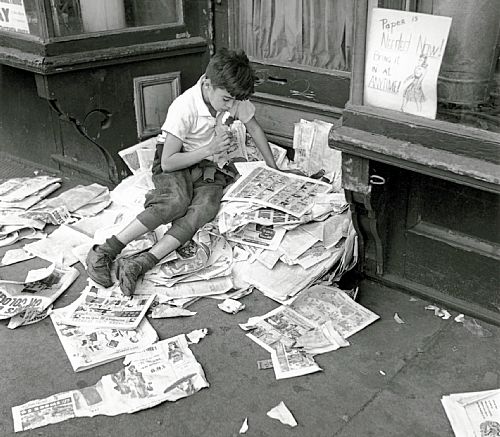
Andre Kertesz - On Reading
The New York Times ran a photo spread on the impossibility of capturing street images of people without anyone head down checking their devices (Misha Erwitt's: Cellphone pre-occupation). The series of pictures shows people in states of preoccupation talking, texting, checking email. (My favorite is the the woman talking next to the Giacommeti statue). In comparison, as Gurbo notes in the preface, "... Kertesz's timeless images of people transported to another world by the intimate process of opening a book or newspaper ... "
Is there an essential difference? Is there a difference between a person texting on a bench versus a person reading a book? Is it more of a disconnection from reality and your surroundings to be staring into a computer screen into the vastness of the internet versus fingers curled around a folded newspaper?
I went back and forth between the collections and I tried to reach a conclusion - is one better than the other? or is is just a symptom of conditioning?
Sounds like a beaten down trope - "digital bad, analog good"
To me, there is an appropriate choice of words for Erwitt's series versus Kertesz's.
Preoccupied vs. absorbed
Distracted vs. transported
Disconnected vs. immersed
It's hard for me to believe that anyone can actually read anything on the internet with it's easy-to-navigate HTML links. Add to that the numerous distractions of messages, tweets, and emails. You don't really travel anywhere on the internet, you simply bounce around.
This is one my favorite images from Andre Kertesz's collection of photographs - On Reading. A boy eating an ice-cream reading the comics section from a scattered bunch of newspapers. Andre Kertesz captures the essence of reading: the solitary, self-absorbed pleasure that transports you to a different place. The only thing that would mar that image would the silhouette of a person talking on the cellphone. Of course, the boy would not notice.
India much after Gandhi: Reading Guha and Mishra
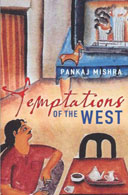
Reading Ramachandra Guha's India after Gandhi and Pankaj Mishra's Temptations of the West. This was rather by accident, but they make good reading side-by-side.
While Guha seems, at least so far, to be quite optimistic of the strength of Indian democracy, reading Pankaj Mishra's Temptations of the West one is left with no illusions about Indian reality of democracy. Mishra is a journalist with a keen eye and a sensibility worthy of a poet. In contrast to the Doon-school,
IIM-educated Bangalorean Guha, Mishra was born in Jhansi, grew up in small-town North India, went to school in Allahabad and spent his youth in Benares. He comes from a different milieu than Guha and correspondingly his views are darker, and I would like to think closer-to-the-ground than the firmly-grounded academic historian. The rest of the book moves on further into the rest of South Asia (more on that later), but the Indian themes, or axes as Guha calls, are pretty much the same - caste-based politics, regionalism, proto-fascist Hindutva, being Muslim in India and others.
I haven't finished reading either book and it would be premature to make a final judgement. One thing is clear that issues raging in the country today were pretty much the same in 1950. While some progress has been made, but much of the tribal population and rest of India lives in a feudal time. This sort of reality is hard to imagine from the eyes of an urban Punekar, now deracinated expat. One hopes that books help us bridge that distance.
I write this at a time when Anna Hazare's strike has just been called off after the government has acceded to his some of Team Anna's demands. The whole affair right or wrong, undoubtably signals the failure of constitutional democracy. Indeed, as Guha's book informs us that Ambedkar, the architect of the constitution, warned that Indians in Free India needed to abjure from Gandhian methods of fasts, hartals, picketing, and the like and use constitutional methods to achieve their ends. Of course, such methods have been mostly ineffective in the last 60 years. It may seem like a Quixotic idea to external observers that citizens need to move heaven and earth just to make elected representatives just accountable: meaning making them do their job.
Meanwhile I seek refuge in books.
Reality melts away.
Lending out Books - Hal Sirowitz
A lesson that I simply fail to learn...
Lending Out Books - Hal Sirowitz
You're always giving, my therapist said.
You have to learn how to take. Whenever
you meet a woman, the first thing you do
is lend her your books. You think she'll
have to see you again in order to return them.
But what happens is, she doesn't have the time
to read them, & she's afraid if she sees you again
you'll expect her to talk about them, & will
want to lend her even more. So she
cancels the date. You end up losing
a lot of books. You should borrow hers.
Posted by hirak on Friday, February 25, 2011
Labels: books, poems, truth about cats and dogs
Review of Peter Hessler's Country Driving
China is a fascinating country. As Indians we love to compare against it. Peter Hessler lived in China for many years and has written wonderful books on the subject. My review of his latest book 'Country Driving' on the Lit blog.
Shooting an Elephant and other essays
This quote by James Wood was particularly insightful:
So Orwell was contradictory: contradictions are what makes writers interesting, consistency is for cookingJames Wood essay on Orwell.
I found the copy gathering dust on one of the shelves at Manney's. Of course, no other bookstore in town had the book.
Half-finished love affair
Reading David Mitchell's Cloud Atlas which is since yesterday overdue at the library. I guess will pay the fines for a few days till I finish it. I was inspired by a quote from the book itself. In the Letters from Zedelghem the musician Robert Frobisher writes:
A half-read book is a half-finished love affair.Guess I must end the love affair even it means a few days delay for the next person in queue.
Brilliant writing. Masterful in the way Mitchell controls the registers and tone of the different voices. There are many of them. More when I am done...
Judgement
A few years ago, the Ann Arbor District Library (AADL) installed automatic check-out machines that scan the barcode, demagnetize your books, inform you about your holds. They have six of these machines and there is no waiting at the checkout desk. The only reason to go to the desk is to pay fines in cash, or for some other unusual request. For almost all transactions, you don't really have to talk to any librarian.
This system has another benefit other than efficiency and speed, an unintended consequence that I wouldn't have realised until I met this girl at a party. She said,
"I really like the AADL system. Now, I can check out books that I am embarrassed to check out in front of a real person".
"Are these dirty books or something?"
"Oh, no, no! These are just what my brother calls trashy mystery novels. I feel now I can check them out without being judged."
There are people who don't read and those who do. Any two non-readers are more alike, than any two readers. There is the John Grisham reader and a reader of Kafka and Murakami. High-brow, low-brow and a sometimes a mix of both. I (like others) always sneak a peak at people in the queue and their book choices and attempt to form some sort of opinion of them. "Oh! so you are the kind of person who reads ABC and hence you must XYZ". And yes, it is true librarians DO look at your book choices. I have many an interesting discussion at the checkout desk. I guess they are polite enough to keep their mouths shut in case they disagree with your choice of reading material.
"I just checked out a whole bunch of books" the girl said with a huge smile on her face.
Now she could read what she wanted to, the judgement of others is suspended. Anonymity allows us sometimes to be what we are not, and sometimes it helps us be who we really are.
Outliers - Old Wine in a New Bottle
Malcolm Gladwell has a gift for sticky phraselogy, and why not? he wrote an entire book on it. His first book The Tipping Point made 'stickiness' a new buzzword. If his first book was about how things/ideas manage to cross a threshold after which there is no looking back, his latest book Outliers is about success itself. He looks at the fundamental reasons for success.
If you don't have time to read through the 300 pages of the book, don't be alarmed. It has chiefly four points. To be successful you need:
1) To work hard (>10,000 hours at something).
2) To be at the right place at the right time.
3) To be only above average smart, but not a genius.
4) To leverage or adjust your cultural advantage/ disadvantages.
None of the above are anything but conventional wisdom. Yet, the book is an interesting read only because Gladwell is so incredibly gifted at paraphrasing the obvious and coming up with interesting examples.
The 10,000 hour rule at first seemed a very good quantification of expertise, but then you realise that it's fairly obvious. A PhD takes about 10,000 hours of work (5 years x 50 weeks/year x 40 hrs/week), and about the same amount of time if you combined an undergrad + master's degree.
Once armed with the right stuff, we all know we have to also be located at correct spot in space and time to even have a chance to grab the opportunity when it comes knocking. It's an interesting observation that being born around 1955 was a good thing for Jobs, Gates, and others as it enabled them to jump into the PC revolution. Ultimately, is this really useful? We are simply unaware what skills will be valuable in 20 years that we can prepare. It's mostly just dumb luck to a large extent that some people come out on top.
We all know that to simply be smart is not enough. This reminds me of Richard Feynman, reported to have an IQ of 124 (just above average), who joked that winning a Nobel prize was no big deal, but to do that with an average IQ of 124, now that was genius!
There is no need to waste any more ink on cultural environment and the important role that it plays in eventual success. Sometimes it makes me guilty to think about my own accident of birth. There was at least one kid running around begging for a meal, who if he had half my advantages while growing up, would have done twice as much.
Most of Gladwell's work is good journalism, but he often falls short of good science. The most astounding leap that he makes is to draw the conclusion that rice farming teaches patience that makes Asians better at math since it teaches persistence and attention to detail. There is something to be said about language and how Asian languages are more calculation-friendly in terms of syntax. But, mathematics is not just merely arithmetic. Even if we consider calculation efficiency as an indicator of math skills, it would be interesting to show that American-born Asians who don't speak their mother tongues are somehow worse at math than their Asian counterparts who do. Indian languages are perhaps syntactically worse as we have more unique words for numbers than English, yet we are pretty good calculators. Why? A quick reason is that we have large families and children have to learn to add and count fast. I dislike these 'gee-whiz' sort of explanations.
Not much love
The local independent bookstore in Ann Arbor - Shaman Drum is closing down and is selling everything at a 35% discount (really 35%, not just 'up to 35%'!). I went there last week and it was a like a a garden that was picked clean of the most beautiful flowers. I know of people who have been camping out there for days.
However, after some searching I did get a few books that I have always wanted at a nice knocked-down price and I wondered how they ever escaped the notice of the thousands of other book lovers in the City of Ann Arbor.
Shaman Drum has(d) the best and most knowledgeable staff and a great selection of books. It was a bookstore's bookstore. It's always great to have people around who can not just show you around, but also make great suggestions and tell you that your choice is excellent. Of course, good service is appreciated, but not everybody would like to pay extra for it. For a college town, it did not have such great discounts compared to Borders across the street. Perhaps, there is something fundamentally wrong in having a book-lover or music lover run a bookstore. I have yet to see them make money on a consistent basis. Either you are a lover or a seller.
When I checked out the lady at the counter packed my books in a Shaman Drum paper bag that read: "Shaman Drum Bookshop (www.shamandrum.com)" on side, and "Love your Local" on the other. Apparently, not much love for the local and independent. Like the paperbag this local, independent bookstore is going to get recycled too.
The math behind galli cricket teams, and other interesting diversions
Group Theory in the Bedroom and Other Mathematical Diversions is Brian Hayes's set of collected essays from the American Scientist.Full marks for the slightly risque title that will pique anyone's interest, but the book has nothing to with mathematics of partner swapping. The subject of the investigation is to find the golden rule for mattress flipping. Mattresses should be flipped periodically to ensure that all sides of the mattress get equal wear. It's easy enough to see that there are 4 possible configurations: (Side A, Side B) x (Top, Bottom). The goal is to find one rule, or a set or rules, that you can apply each time to perform a set of operations that ensures that you end up cycling through all 4 configurations.
If you only flip (along the long or short axis) you cycle through only two sides - A and B. If you only rotate in a plane then you cycle through - Top and Bottom. Using group theory, Hayes shows why there is no golden rule. You cannot perform the same set of operations again and again because the mattress is a Klein-4 group . A rotate and a flip along the short axis is the same as a flip on the long axis. Any set of two operations are equivalent to one operation. This proves to be the undoing of any rule, as we know that any ONE set of operations is not enough to cycle through all 4 configurations. So, you either need a fixed schedule, or a set of markers to ensure you do an opposite set of operations.
Being a kinda random fellow, I best liked Hayes's analysis of the effects of random flipping. If you randomly performed any one operation on a quarterly-basis then, on average, one side will get 31% of the wear instead of ideal 25%. A rather tolerable discrepancy of 6%. Then he goes on to discuss tire rotation and shows why that is completely different beast since it is a cyclic-4 group and hence there is a golden rule - "quarter turn clockwise (or anti-clockwise)".
What is most interesting about the book is that all these mathematical diversions start as anecdotes and rather innocuously. Consider the problem of partitioning a set of players into two teams: a problem that is encountered and solved on thousands of galli cricket and football 'fields' every day. The usual practice is to select two captains who then toss to decide who picks first. Then they go turn-by-turn to pick the rest of the players. Naturally, the players are chosen in order of ability. In general, this rule results in fairly balanced teams. Hayes calls this the Greedy Algorithm, because at each step the largest number (if you assigned numerical values to the strengths of the players) is chosen in each partition. In reality, of course this partitioning problem is quite a hard one, more technically, it's an NP complete problem and there are number of other algorithms, including the Karmarkar-Karp difference algorithm, but no optimal one. Then Hayes goes on to show why this does not matter on the playing field because on a log scale, abilities don't differ that much between strongest and weakest players and the simple 'greedy' partitions are reasonable without the need for fancy partitioning.
I greatly enjoyed reading the other chapters on namespaces, gear train ratios, and finding the continental divide. If only, mathematics was taught this way in schools.
Murakami on Running
Murakami's memoir on running: On the lit blog. A great rambling, read on running and writing, and living.
New review on lit blog: James Wood's How Fiction Works
My lovefest with books continues this week with a review of
James Wood's: How Fiction Works.
I am off to read some more...
Top ten books on Gutenberg
#1 The Outline of Science, Vol. 1 (of 4) by J. Arthur Thomson (21431)
#2 Manners, Customs, and Dress During the Middle Ages and During the Renaissance Period by P. L. Jacob (16654)
#3 Illustrated History of Furniture by Frederick Litchfield (11252)
#4 The Kama Sutra of Vatsyayana by Vatsyayana (10522)
#5 Pride and Prejudice by Jane Austen (9269)
#6 Searchlights on Health by B. G. Jefferis and J. L. Nichols (9007)
#7 History of the United States by Charles A. Beard and Mary Ritter Beard (8348)
#8 Our Day by William Ambrose Spicer (8004)
#9 The Adventures of Huckleberry Finn by Mark Twain (7354)
#10 The People's Common Sense Medical Adviser in Plain English by Ray Vaughn Pierce (6712)
I stumbled across this while searching for some other texts. Only #4, #5 and #9 are the well-known ones. It seems rather bizarre that people are downloading the History of Furniture, the Dress from the Middle Ages more often than the Kamasutra or Pride and Prejudice (No need for a gender-based query, we all know!). Good to know that Science is trumping them all, or is the web full of only dweebs?
I am really perplexed. Any ideas?