Showing posts with label history. Show all posts

India much after Gandhi: Reading Guha and Mishra

Reading Ramachandra Guha's India after Gandhi and Pankaj Mishra's Temptations of the West. This was rather by accident, but they make good reading side-by-side.

For most historians, Indian history ended with Partition, or with some extension, with the assassination of Mahatma Gandhi. The books on India history after Independence, he writes, can be counted on the fingers of one hand, or two if one is more broad-minded. Guha's book was published in 2007, released to presumably coincide with the 60th year of India's Independence, is weighty and 700+ pages long. Only being about third through the book, I oddly felt that it should have been longer. Guha writes with an extraordinary skill: the laborious scholarship and copious footnotes do not disturb the urge to keep turning the pages. As far as I can note, Guha is content, as he should be to, to mostly describe and leave conclusions to the reader. I did somewhat catch some of the legendary debate in press between Ms. Arundhati Roy and him, though I am eager to understand some of his political convictions and motivations. While Ms. Roy did claim in an interview that her views with Mr. Guha's were worlds apart, at least the have an environmental and social conscience. A sort of conscience that I see lacking in many of my local peers, who have seemed to embrace "India Shining" with careless abandon.

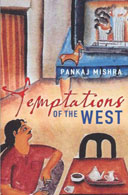
While Guha seems, at least so far, to be quite optimistic of the strength of Indian democracy, reading Pankaj Mishra's Temptations of the West one is left with no illusions about Indian reality of democracy. Mishra is a journalist with a keen eye and a sensibility worthy of a poet. In contrast to the Doon-school,
IIM-educated Bangalorean Guha, Mishra was born in Jhansi, grew up in small-town North India, went to school in Allahabad and spent his youth in Benares. He comes from a different milieu than Guha and correspondingly his views are darker, and I would like to think closer-to-the-ground than the firmly-grounded academic historian. The rest of the book moves on further into the rest of South Asia (more on that later), but the Indian themes, or axes as Guha calls, are pretty much the same - caste-based politics, regionalism, proto-fascist Hindutva, being Muslim in India and others.
I haven't finished reading either book and it would be premature to make a final judgement. One thing is clear that issues raging in the country today were pretty much the same in 1950. While some progress has been made, but much of the tribal population and rest of India lives in a feudal time. This sort of reality is hard to imagine from the eyes of an urban Punekar, now deracinated expat. One hopes that books help us bridge that distance.

I write this at a time when Anna Hazare's strike has just been called off after the government has acceded to his some of Team Anna's demands. The whole affair right or wrong, undoubtably signals the failure of constitutional democracy. Indeed, as Guha's book informs us that Ambedkar, the architect of the constitution, warned that Indians in Free India needed to abjure from Gandhian methods of fasts, hartals, picketing, and the like and use constitutional methods to achieve their ends. Of course, such methods have been mostly ineffective in the last 60 years. It may seem like a Quixotic idea to external observers that citizens need to move heaven and earth just to make elected representatives just accountable: meaning making them do their job.

Meanwhile I seek refuge in books.
Reality melts away.

The Prime of Mr. Hirak Parikh

At exactly 2245 EST, which is 0815 IST, the digits on my clock will flip. No ordinary flip this one. Thirty rotations round the sun to be exact. In a sense it's just another day, right? That was pretty much the whole point of James Joyce's Ulysses (He did take his time to describe it though). The beauty of an ordinary day. Unlike Stephen Daedalus, I am trying to confront the possibility of an extraordinary day.

But why 30? Technically speaking it's the 30th anniversary, but my 31st birthday (0-based counting rocks!). On some level, it's special, though in terms of other units of time counted it's rather quotidian -
* it is 10,956 days, 15 hours, 45 minutes and 0 seconds or
* 29 years, 11 months, 29 days, 15 hours, 45 minutes
* 946,655,100 seconds
* 15,777,585 minutes
* 262,959 hours (rounded down)
* 1565 weeks (rounded down)
Courtesy: www.timeanddate.com

Then again, in term of SI units - another day to celebrate is 1E9 seconds on the planet which is about 31.6887646 years. So, somewhere in February 2012? For most people their billionth second on earth passes by in an instant, without fanfare or even the slightest notice. Given that our lives revolve on the order of days, this significant moment just passes by. I can take solace in the fact, that I am not that old, yet!

Still 30 is unique not because it signals the end of the 20s, or the end of my salad days, but for a curious fact that '30' is the largest possible product of first few consecutive primes.
1x2x3x5=30.

The next possible combination is 1x2x3x5x7=210 which seems out of the realm of human longevity.

I take this as divine sign from the God of Numbers that this year is the prime(s) of my life. So the BIG '3 and 0' is really an important marker.

Goodbye 20s, Welcome Hirak 3.0.

Bad news: More grey hair
Good news: We are out of beta. Way, way out of beta...

Classical Convention

Today's issue of the BBC magazine describes proper clapping etiquette:
To Clap or Not To Clap.

At a rock concert it is considered acceptable to applaud like a maniac, whoop, holler, punch the air, and even shout "rock 'n' roll" at the end of every song, should you see fit. But this is not the case in the world of classical music. You will find aficionados who sneer at "those people who clap after every movement". And the Time Out listing magazine's classical editor Jonathan Lennie has caused a minor kerfuffle in this rarefied world by going one step further and criticising those people who clap the microsecond a concert is over. In an open letter to the "Loud Clapping Man Who Sits Behind Me At Concerts", Lennie wrote: "Having sat through a long and profound work, why do you have to start making a racket as soon as you perceive it to be over?"
... He insists that for some sombre pieces, a period of dignified silence after the last note is played is essential to appreciation.
These conventions have been around for a while and as Alex Ross points out(New Yorker article) most of these conventions are bourgeois inventions. They made classical music such a class act in the middle of the 19th century. He quotes James Johnson’s “Listening in Paris,” describing a typical night at the Paris Opéra in the years before the French Revolution:
While most were in their places by the end of the first act, the continuous movement and low din of conversation never really stopped. Lackeys and young bachelors milled about in the crowded and often boisterous parterre, the floor-level pit to which only men were admitted. Princes of the blood and dukes visited among themselves in the highly visible first-row boxes. Worldly abbés chatted happily with ladies in jewels on the second level, occasionally earning indecent shouts from the parterre when their conversation turned too cordial. And lovers sought the dim heights of the third balcony—the paradise—away from the probing lorgnettes.
He further writes:
In other words, the opera served mainly as a playground for the aristocracy. The nobles often possessed considerable musical knowledge, but they refrained from paying overt attention to what the musicians were doing. Indeed, silent listening in the modern sense was deemed déclassé. Johnson quotes a nobleman writing, “There is nothing so damnable as listening to a work like a street merchant or some provincial just off the boat.”
And to think of all that clamor about clapping at the right moment.

City of Djinns

There is something odd about rusticating in the Georgia countryside under a hammock and to be reading a book written by a Brit on an Indian city. William Dalrymple is one the finest scholars of the late Mughal era and one can understand his fascination and love affair with Delhi, which he calls The City of Djinns. The book, an account of a year in Delhi, is a fascinating portrait of India's capital city. He writes, "Delhi is a city disjointed in time, a city whose different ages lay suspended side by side as in aspic, a city of djinns".

The book flits back and forth between the past and present as Dalrymple explores the city and uncovers its secrets - the mansions, the eunuchs, Unani medicine, Lutyen's Delhi, etc. Starting with the riots following Indira Gandhi's death in 1984, the book spirals backwards going back further and further in time till it ends with a solitary sadhu on Nimbodh Ghat. For a Brit, Dalrymple doesn't have much sympathy for the British era and his portraits of the Anglo-Indians and Brits who chose to be 'left behind' aren't sensitive but comic. They are a people suspended in an age and time that has long passed. For one particular class of Anglo-Indians he does make an exception and those being the 'White Mughals', notably Col. James Skinner and William Fraser (the ancestor of his wife Victoria Fraser). One can see why these Brits who 'went native' are so fascinating and to do justice he had to write a larger piece of work - The White Mughals. For these class of Brits he is overcome with wistful nostalgia and anguish over history's great missed opportunity. For a brief period the English, Hindu, and Muslim world lived side-by-side in an odd, harmonious marriage before the Revolt of 1857 and Victorian mores destroyed that idea forever.

Delhi doesn't boast the glitz or the financial muscle of Mumbai, and isn't anyone's idea of the cultural capital either. Around partition Delhi was a city where even milkmen and prostitutes could quote Dagh, Mir, and Ghalib. The indigenous poets and artists have long departed. What remains of culture is transplanted from elsewhere. Delhi, for most, is a political circus, where the Parliament meets, the location of the annual Republic Day Parade, and incidentally also the home of the Red Fort. Monuments are really empty if the culture around it has vanished. Dalrymple's central thesis is that the Partition all but killed Delhi's cultural richness that resulted from the mixing of the Hindu and Muslim worlds from the Mughal times. The Partition exodus resulted in the city being overrun by the boorish and loud Punjabis who have no love nor understanding of the city's language or culture. Modern Delhi is divided into two halves - the decaying and dying Mughal Old Delhi and vulgar and conspicuously consumptive Punjabi New Delhi. But as he explores Delhi's past, Dalrymple cannot escape the Punjabis who now run the city and grudgingly he gives them their due. He rents an apartment from the iron-fisted Partition-refugee Mrs. Puri and is driven around by the irrepressible Balwinder Singh from the International Backside Taxi (backside denoting its location behind the International Centre).

The world that he writes about is from the late 1980s (the book was published in 1993) where he had many encounter with the famous Indian bureaucracy, but things have not changed much since at least in terms of preserving history, culture, and architecture. He writes about two brothers from a family of nastaliq calligraphers. One brother continues to preserve the dying art and the other, the more pragmatic of the two, has all but shunned it in favour of taking soft-porn photos in the same premises where his ancestors laboured for princes, omrahs, and scholars. The death and decay continue. Monuments are still uncared for, valuable papers are still rotting in basements, and grotesque improvements and changes are being made in places that are of great historical importance.

In middle of this captivating account, the mid-morning Georgia sun made it presence felt and I had to run indoors for cover. I was halfway across the world but this plot of earth is only 10 degrees north of Delhi and in any case the red earth of Georgia does remind me of the Red Fort.